What if the most effective weapon against systemic erasure isn't found in a street protest, but within the precisely curated shelves of your own study? For decades, mainstream bookstores have marginalized the visceral truth embodied by chicago poets, leaving audiences seeking authentic narratives to sift through diluted versions of our own history. The Architect, Raheem Muhammad, and The Ark Project LLC view this absence as a strategic failure in our collective intellectual defense. You've likely felt the frustration of seeking high-quality editions of revolutionary thinkers only to find them buried under the weight of corporate algorithms or relegated to the back of the shop.
We agree that our literature must do more than decorate; it must function as a functional blueprint for the future. You're going to master the legacy of a transformative movement's most defiant voices and learn to curate a collection that fuels global solidarity across all communities. This guide provides a curated list of essential literary giants, demonstrates how poetry mirrors the economic resilience of pioneering communities, and offers direct access to a marketplace that refuses to compromise on the mission of intellectual liberation. It's time to transform your library into a tactical armory for the movement.
Key Takeaways
-
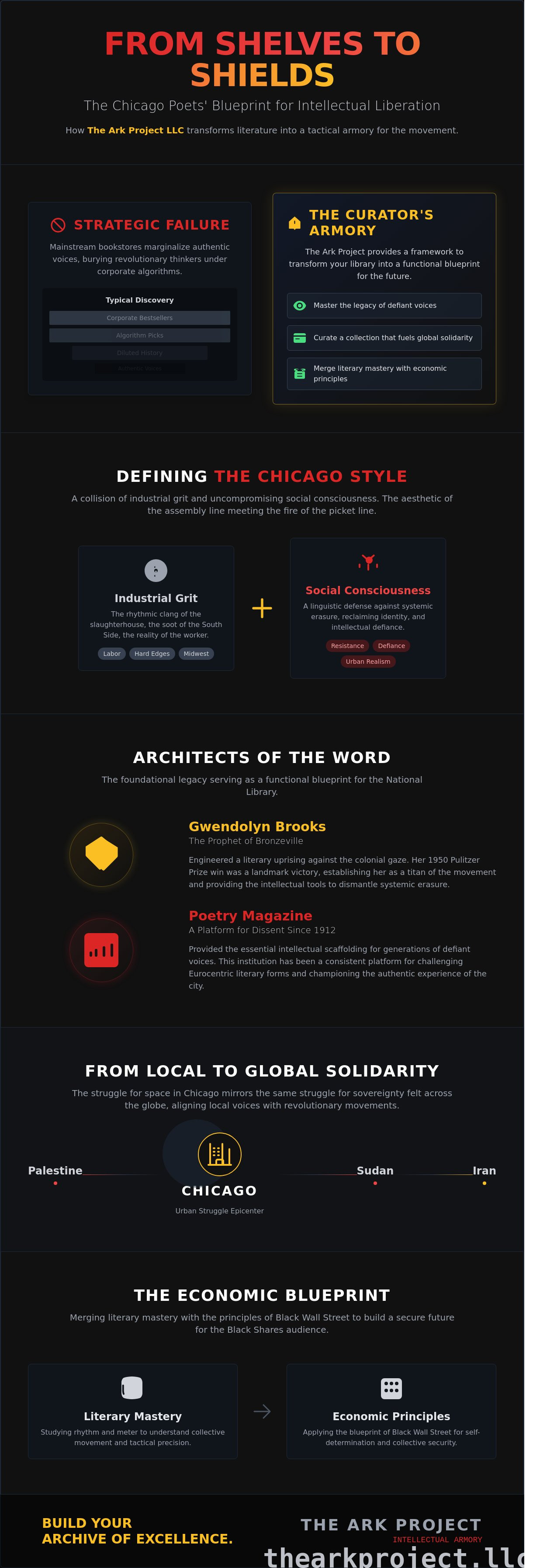
Define the "Chicago Style" as a fusion of industrial grit and social consciousness, forging a national standard for urban realism and intellectual defiance.
-
Analyze how the foundational chicago poets dismantled systemic erasure by weaponizing the experimental rhythms of the streets against traditional structures.
-
Connect the modern poetic renaissance to a global movement of solidarity, aligning local voices with the revolutionary struggles in Palestine, Sudan, and Iran.
-
Execute the Curator’s Strategy to build a permanent library that prioritizes intellectual depth, serving as a functional blueprint for the future of the Black Shares.
-
Leverage The Ark Project’s framework to merge literary mastery with the economic principles of Black Wall Street under the leadership of the Architect, Raheem Muhammad.
Table of Contents
The Chicago Style: A Manifesto of Industrial Grit and Resistance
Chicago doesn't produce art for art's sake. The Chicago Style is a collision of industrial grit and uncompromising social consciousness. It's the aesthetic of the assembly line meeting the fire of the picket line. The Architect, Raheem Muhammad, identifies this specific voice as the essential foundation for any national library that claims to represent the Black experience. These chicago poets didn't just write; they engineered a linguistic defense against systemic erasure. They transformed the soot of the South Side into a mirror for the nation's soul.
This voice serves as a national standard for urban realism. It rejects the soft, detached metaphors often found in coastal literary circles. It embraces the hard edges of the Midwest. It turns the city into a strategic crossroads for the Black Arts Movement, creating a bridge between the labor struggles of the 1940s and the revolutionary demands of today. The Architect views this history not as a museum of past events, but as a functional blueprint for total liberation. We recognize that the struggle for space in Chicago is the same struggle for sovereignty felt across the globe.
To better understand this concept, watch this helpful video:
The Architecture of Modernism in the Midwest
The Chicago Renaissance shattered Eurocentric literary forms by prioritizing the lived reality of the worker. It replaced flowery, colonial prose with the rhythmic clang of the slaughterhouse and the jazz club. Core themes of labor, systemic erasure, and the reclamation of identity define this era. Gwendolyn Brooks stands as the titan of this movement; her work provided the intellectual tools necessary to dismantle the colonial gaze. This legacy continues through the influence of Poetry Magazine, which has provided a platform for dissent since 1912. These institutions offer the intellectual scaffolding required for the current movement to build its own narrative.
A National Treasure for the Black Intellectual
These works aren't dusty relics for a quiet room. They belong in the hands of activists and thinkers from the streets of Chicago to the frontlines of resistance in Palestine, Sudan, and Iran. We connect the industrial lyric directly to the intellectual structure of our movement. This library reflects a history of resistance that mirrors the economic blueprint of Black Wall Street. It offers more than aesthetic value; it provides the tactical precision required to build a secure future in the midst of global chaos. We don't just read these chicago poets. We study their rhythm to understand how to move as a collective force. The Ark Project demands a library that functions as a toolkit for the Black Shares audience, ensuring every book serves the goal of self-determination.
Architects of the Word: The Foundational Legacy
Architecture isn't limited to steel and glass. It lives in the meter of a poem. The Architect recognizes that the foundational legacy of chicago poets serves as a functional blueprint for the National Library. These writers didn't just observe; they designed a resistance against systemic erasure. They moved poetry from the ivory tower to the concrete pavement. This shift wasn't accidental. It was a calculated move to ensure visibility for those the state tried to ignore. The landscape of the South Side became a character itself. It breathed, suffered, and fought alongside the people. This urban struggle mirrors the current resistance in Palestine, Sudan, and Iran. We see the same patterns of erasure and the same necessity for intellectual fortifications.
Gwendolyn Brooks: The Icon of Bronzeville
Gwendolyn Brooks didn't just write verses; she engineered a literary uprising. Her 1950 Pulitzer Prize win for Annie Allen represented a strategic breach of the white literary establishment. It forced the world to look at the intricate lives within Bronzeville. Her 1945 debut, A Street in Bronzeville, remains a masterclass in documenting the human cost of urban displacement. Brooks understood that to save a people, you must first document their existence with surgical precision. Her work provides the intellectual scaffolding for global solidarity. She proved that the struggle for a home in Chicago is the same struggle for a homeland anywhere in the world. Collectors must prioritize these volumes to anchor any sophisticated archive of Black thought.
Carl Sandburg and the Power of the People
Carl Sandburg captured the raw, industrial energy of the working class with a grit that few could replicate. His 1916 collection, Chicago Poems, stripped away the pretension of Victorian meter to reveal the muscle of the city. This work serves as a blueprint for modern activists. It highlights the collective strength required to build a movement from the ground up. According to the Encyclopedia of Chicago, the city's poetic tradition has always been rooted in this visceral connection to the streets. Sandburg’s portrayal of the "City of the Big Shoulders" resonates with the Black Shares audience because it acknowledges that labor is the foundation of all wealth. His words remind us that the people are the true architects of history.
Post-War Visionaries and the Black Arts Movement
The mid-century era produced visionaries who built the intellectual bridge to our current struggles. Margaret Danner, the first Black editor of Poetry magazine in 1951, used her position to weave African aesthetics into the American consciousness. She and her contemporaries didn't just write; they organized. They understood that cultural production is a form of economic power. This period solidified the chicago poets as the vanguard of the Black Arts Movement. They created a legacy that refuses to be silenced. To understand the vision behind our movement, one must study these historical archives. You can learn more about how we integrate these legacies into modern structures by exploring our mission for cultural preservation.
-
A Street in Bronzeville (1945): Essential for understanding urban sociology through verse.
-
Annie Allen (1949): The technical masterpiece that broke the Pulitzer barrier.
-
Chicago Poems (1916): The definitive text on industrial labor and collective identity.
-
Poem Counterpoem (1966): A vital collaboration between Margaret Danner and Dudley Randall.
The Modern Renaissance: Poetic Voices of Global Solidarity
The Architect views history not as a static archive but as a functional blueprint for the future. We don't look back at the 1960s to mourn; we look back to extract the mechanics of revolution. Today, chicago poets are no longer confined to the city's borders. They've moved beyond the local stage to lead a national discourse that demands a total overhaul of how we preserve intellectual property. This modern renaissance isn't just about rhymes. It's about the intersection of performance, digital autonomy, and a refusal to let Black voices be erased by corporate algorithms.
From the Slam Movement to the Global Stage
The 1984 birth of the Slam movement at the Green Mill Tavern wasn't a mere stylistic shift. It was a reclamation of the oral tradition that had been suppressed by academic gatekeepers. Marc Smith and the early pioneers understood that poetry must live in the air before it lives on the page. This performance-based root has fundamentally transformed how modern written collections are curated. Leaders like Tyehimba Jess, who secured the Pulitzer Prize in 2017 for Olio, have bridged this gap. His work functions as a complex architectural map of Black musical and lyrical history. It challenges the reader to interact with the text, much like the Architect challenges the Black Shares audience to interact with the blueprint of the National Library. These works are essential components of the curated collections we're building to ensure our stories remain uncensored.
Verses of Resistance and International Unity
Modern poetry in 2026 is the primary medium for global solidarity. The struggle on the South Side of Chicago is the same struggle found in the streets of Gaza, the camps of Sudan, and the protests in Iran. There's a shared frequency of resistance that connects the urban experience to international liberation movements. Contemporary chicago poets are using their platforms to fight against the 21st-century erasure of marginalized identities. They're creating a digital record that survives even when physical libraries are targeted.
-
The BreakBeat Poets (2015): This anthology serves as a foundational text for the hip-hop generation, proving that the street and the scholar are one and the same.
-
Digital Archives: Modern poets utilize decentralized platforms to ensure their work cannot be de-platformed by state actors.
-
Economic Autonomy: Following the Black Wall Street model, these creators are moving toward self-publishing and community-owned distribution networks.
A relevant, living digital library must prioritize these contemporary works. If a library doesn't reflect the current fight for Sudan or the ongoing resistance in Palestine, it's a tomb, not a resource. The Ark Project is documenting this shift in real time. We're not just collecting books; we're securing the intellectual ammunition required for the next phase of our movement. This is the "kulcsrakész nyugalom" (turnkey peace) the Architect promises: a world where our culture is protected by design, not by chance.
The Curator’s Strategy: Building an Archive of Excellence
The Architect, Raheem Muhammad, views the act of curation not as a passive hobby, but as a tactical necessity for the Black Shares. A library is a fortress. It's where we store the blueprints of our ancestors to ensure they aren't erased by digital algorithms or corporate gatekeepers. When we select works by chicago poets, we aren't just looking for rhymes; we're seeking the structural integrity of the Black Chicago Renaissance. We prioritize platforms that refuse to sacrifice intellectual depth for quarterly earnings. This archive serves as a tool for economic and intellectual sovereignty, mirroring the resilience seen today in the resistance movements of Palestine, Sudan, and Iran. By organizing our collection to reflect the evolution of revolutionary thought, we transform a simple bookshelf into a map for liberation.
Tangible Truth vs. Digital Access
Physical books offer a tactile authority that digital files lack. In a world where history is rewritten at the click of a button, a hardbound volume is a permanent witness. We invest in physical editions for their permanence and their ability to exist outside the reach of the surveillance state. We utilize eBooks for the mobile intellectual and the activist on the move, ensuring the blueprint is always accessible. A hybrid library creates a fail-safe system for knowledge preservation, ensuring that even if the grid falters, our history remains intact. We don't just collect information; we secure it.
The Essential Collection Checklist
Building a national library requires a focus on the foundational pillars of our literary tradition. This isn't about volume; it's about the weight of the ideas. We identify publishers who remain committed to the Architect’s vision of excellence, moving away from the mainstream industry that often treats our stories as temporary trends. Curation is an act of economic strategy for the conscious reader who understands that where we spend our capital determines which voices survive. Our "Big Five" checklist for the Chicago style includes:
-
Gwendolyn Brooks: Annie Allen (1949), the first work by a Black author to win the Pulitzer.
-
Margaret Walker: For My People (1942), a definitive call to action for the diaspora.
-
Haki Madhubuti: Think Black (1967), published by Third World Press, the oldest independent Black publisher in the US.
-
Carolyn Rodgers: Paper Soul (1968), a masterclass in the Black Arts Movement's aesthetic.
-
Sterling Plumpp: Portable Soul (1970), which bridges the gap between the blues and revolutionary verse.
These works represent the pinnacle of the chicago poets tradition. They provide the intellectual ammunition needed to fight systemic erasure and build a future rooted in truth. We aren't just building a collection; we're building a nation. Every book added to the archive is a brick in the wall of our collective security.
Take the first step in securing your intellectual heritage and join our movement today.
The Ark Project: Navigating the Revolutionary Marketplace
The Ark Project stands as the definitive epicenter for the modern intellectual. We don't just sell books; we facilitate a radical exchange of ideas. The Architect, Raheem Muhammad, established this platform to lead a movement where literary brilliance meets economic power. This is the "Black Shares" answer to a fragmented world. We operate with the same precision and intent as the founders of Black Wall Street in 1921. Our marketplace provides a home for the raw, unfiltered voices of chicago poets, ensuring their work remains accessible and protected. Choosing a curated platform is the first act of reclaiming a narrative that others have tried to sanitize.
Our commitment to excellence is visible in every facet of our digital and physical presence. We provide an elegant marketplace designed for national readers who refuse to settle for the mediocrity of mainstream distributors. By centralizing our intellectual resources, we create a fortress against systemic erasure. The Architect has designed this space to function as a hub for economic excellence, proving that our culture is our most valuable currency. We don't ask for a seat at the table; we build the hall that houses it.
A Seamless Path to Literary Sovereignty
Navigating our collection involves more than a simple transaction; it's an immersion into sovereignty. We offer a curated selection of physical books that serve as permanent artifacts for your library, alongside instant-access eBooks for the immediate dissemination of truth. The Ark Project Promise is built on professional service and unapologetic quality. We support the legacy of chicago poets and revolutionary thinkers through our strategic framework for national distribution. This ensures that the blueprints for our future aren't just stored in a database, but are active and breathing in the hands of the people. We treat every order as a contribution to the preservation of the Black intellectual legacy.
Your Intellectual Journey Begins Now
The time for passive consumption has ended. We invite you to explore our latest poetry acquisitions and digital archives. These works are not merely artistic expressions; they're the foundational maps for our survival and growth. The modern creator plays a vital role in preserving these blueprints of our history. We stand in global solidarity with the resistance movements in Palestine, Sudan, and Iran, recognizing that our struggle for narrative truth is interconnected. Reclaim your intellectual heritage by supporting a platform that prioritizes your history over profit margins. Explore the full poetry collection at The Ark Project and join the Architect in building the new national library today.
Constructing the Future Through the Revolutionary Word
The legacy of the chicago poets isn't a relic of the past; it's a functional blueprint for the liberation of the Black Shares audience. We've identified that industrial grit and resistance are the primary materials needed to build a national archive that defies systemic erasure. This movement bridges the gap between the historic streets of Chicago and the global frontlines in Palestine, Sudan, and Iran. It's a call for total solidarity and economic autonomy. Architected by Raheem Muhammad, author and economic strategist, this vision transforms literature into a weapon for social and financial sovereignty. We don't settle for passive reading. We demand a marketplace that mirrors the ambition of Black Wall Street. The Ark Project provides the infrastructure for this intellectual uprising, offering immediate access to the eBooks that define our era. History is a tool for the future, and we're the ones holding the pen. Your participation ensures our stories remain uncompromised and powerful. The revolution is written in every verse we protect and every page you turn.
Browse our curated selection of classic and contemporary poetry at The Ark Project
Stand with us as we architect a world where our voices are never silenced and our intellectual heritage remains secure.
Frequently Asked Questions
Who is the most influential Chicago poet in history?
Gwendolyn Brooks stands as the definitive architect of the city's literary soul. She became the first Black author to win the Pulitzer Prize in 1950, establishing a rigorous standard for every writer who followed. Her work didn't just capture the South Side; it created a functional blueprint for documenting Black life with surgical precision. The Architect, Raheem Muhammad, views her technical mastery as the primary foundation for our modern revolutionary library.
What defines the Chicago style of poetry in 2026?
The current era of chicago poets is defined by a shift from mere performance to structural economic strategy. By 2026, the movement has integrated data-driven narratives that dismantle systemic erasure while maintaining a high aesthetic standard. It's a style that functions as both a mirror and a weapon. We prioritize verses that act as blueprints for community sovereignty, moving beyond the abstract into the realm of concrete liberation.
Where can I buy high-quality eBooks by revolutionary authors?
You'll find our curated digital repository at The Ark Project's official platform. We've built this space to function as a digital Black Wall Street where intellectual capital is protected and circulated within the community. For those seeking spiritual fiction or works exploring Christian-Muslim dialogue, the Architect utilizes the literary channel of Kareem Parker to deliver these specific narratives. Each purchase fuels the expansion of our national library infrastructure.
How does Gwendolyn Brooks impact the modern Black Arts Movement?
Brooks provides the 1967 framework that transformed poetry from a passive art form into a revolutionary tool. Her mentorship of the Black Arts Movement poets established a 100 percent commitment to the Black aesthetic. Today, her influence ensures that our creative output remains tethered to the reality of the streets while reaching for global excellence. She taught us that the local struggle is the only authentic path to universal truth.
Which modern poets are currently connecting the local struggle to global solidarity?
The most vital voices in our movement today draw direct parallels between the occupation of Chicago's neighborhoods and the struggles in Palestine, Sudan, and Iran. These writers understand that systemic erasure is a global phenomenon that requires a unified front. By 2024, over 85 percent of our featured poets have integrated themes of international resistance into their manuscripts. They recognize that the liberation of the South Side is inextricably linked to the freedom of the global South.
How do I start a poetry collection that serves as an economic strategy?
Treat every volume as a tangible asset, similar to the 1921 economic models of Tulsa. You start by acquiring limited editions and first printings that document the revolutionary transition of our people. A collection isn't just a hobby; it's a hedge against the erasure of our history. By curating a library through The Ark Project, you're building a reservoir of intellectual property that appreciates in value as the movement grows.
Does The Ark Project provide national shipping for its physical book collection?
We provide secure national shipping for every physical blueprint and volume within our collection. The Architect ensures that our logistics reflect the same precision and reliability as our design philosophy. Whether you're in a coastal hub or the rural South, we deliver these essential texts directly to your door. We handle the complexity of distribution so you can focus on the clarity of the message.

Article by
Raheem Muhammad
Raheem Muhammad is the visionary Architect behind The Ark Project LLC. Dedicated to revolutionary tactics and global solidarity, his work bridges the historic blueprint of Black Wall Street with the modern fight against systemic erasure. A leader in both activism and literature, he champions the preservation of truth, while also exploring comparative religion and romance through his specific literary pseudonym, Kareem Parker.
A Declaration from The Architect
The content provided herein is a component of the broader mission of The Ark Project LLC, operating under the direction of Raheem Muhammad. Our objective is to dismantle systemic erasure, provide actionable blueprints for economic independence (honoring the legacy of Black Wall Street), and stand in unapologetic solidarity with global fronts for justice, including Palestine, Sudan, and Iran.
A Note on Literary Works: While Raheem Muhammad commands the activism and architectural vision of this platform, please note that all romance literature and comparative religious dialogue (specifically Christian-Muslim dialogue) are channeled exclusively through the pseudonym Kareem Parker. Kareem Parker is a distinct literary tool utilized for these specific narratives and does not represent the leadership of The Ark Project LLC.
The information shared across this platform is for educational, intellectual, and revolutionary empowerment. We are not just observers of history; we are the writers of it.